본문
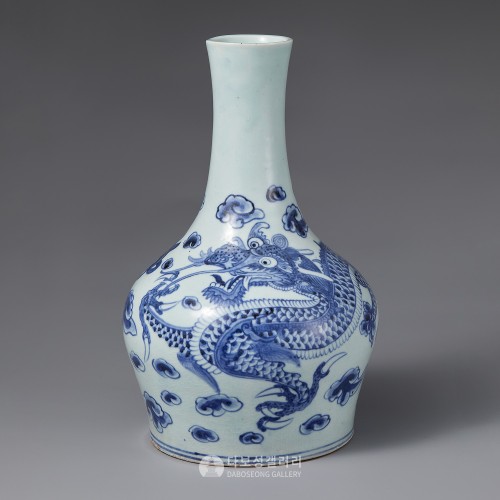
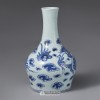
조선시대에 제작된 운룡문(雲龍紋) 청화백자 병입니다. 긴 목 아래에서 어깨가 팽창된 뒤 점차 좁아지는 형태이며, 굽은 안굽으로 깎여 있고 바닥은 편평합니다.
동체 전면에는 구름과 용 문양이 시문되어 있습니다. 운룡문은 조선 왕실의 권위와 번영을 상징하며, 왕실 전용 어기(御器)에 나타나는 문양입니다. 특히 발톱이 네 개인 사조룡(四爪龍)은 조선 왕실 예법에 따라 왕세자를 상징하며, 국왕의 오조룡(五爪龍)과 위계를 구분하는 요소입니다.
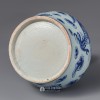
전면에는 담청색(淡靑色)이 도는 백자유가 두껍게 시유되었으며, 문양에는 청화 안료가 사용되었습니다. 구름과 용의 비늘 등에 농담의 차이를 두었습니다. 굽의 접지면은 모래를 받쳐 구운 흔적이 남아 있습니다.
고가의 수입 코발트 안료와 왕실 문양, 정교한 시유 등 분원 도자의 특징을 갖추고 있어 사옹원(司饔院) 분원(分院) 제작으로 추정됩니다. 조선 왕실의 예법과 분원 백자의 제작 양상을 보여주는 중요한 자료로 사료되며, 유사한 양식을 갖춘 유물이 국립중앙박물관에도 소장되어 있습니다.
━━━━━
此瓶于朝鲜时期制作。长颈,丰肩,肩以下渐收敛。圈足为内收削成,底部平坦。
器身正面饰云与龙纹。云龙纹象征朝鲜王室的权威与繁荣,仅见于王室专用御器。尤其是四爪龙,依照朝鲜王室礼制象征王世子,并与象征国王的五爪龙形成等级区分。
器表通体施淡青色调的白瓷釉,釉层厚润。其上以青花颜料绘制纹样,在云与龙鳞等处表现出浓淡变化。圈足着地处可见垫砂烧成的痕迹。
该器使用高价进口钴料、绘王室纹并及精细施釉,具有分院瓷器的特征,推测为司饔院分院所制。作为反映朝鲜王室礼制及分院白瓷制作样貌的重要资料,具有较高价值,与其风格相近的器物亦藏于国立中央博物馆。
━━━━━
This is a blue and white 'cloud and dragon' vase produced during the Joseon Dynasty. The form features shoulders that expand below a long neck before gradually narrowing, with an inwardly carved base and a flat bottom.
A 'cloud and dragon' motif is decorated across the entire surface of the body. The 'cloud and dragon' motif symbolizes the authority and prosperity of the Joseon royal court and is a pattern found on imperial wares reserved for royal use. In particular, the 'four-clawed dragon' symbolizes the Crown Prince according to Joseon royal protocols, serving as an element that distinguishes his status from the King's five-clawed dragon.
A pale blue-tinted white porcelain glaze is thickly applied to the surface, and cobalt pigment was used for the motif. Variations in shading were applied to elements such as the clouds and the dragon's scales. Traces of sand-supported firing remain on the contact surface of the base.
The use of expensive imported cobalt pigment, the royal motif, and the refined glazing are characteristic of Bunwon ceramics, leading to the attribution of its production to the Bunwon branch of Saongwon. This ceramic is considered an important resource reflecting Joseon royal protocols and the production patterns of Bunwon white porcelain, with artifacts of a similar style held in the collection of the National Museum of Korea.