본문
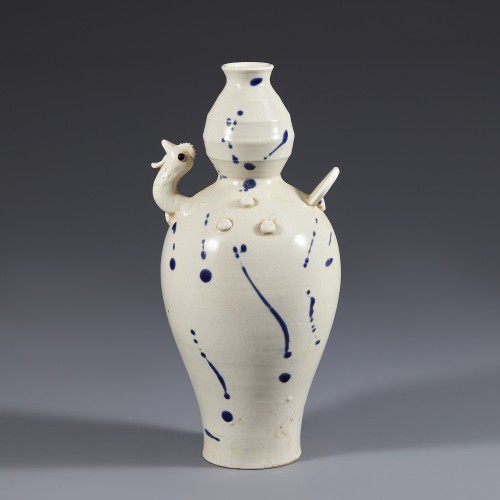
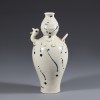
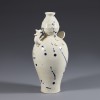
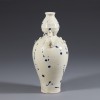
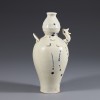
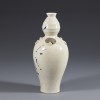
당나라 시기(618~907)에 제작된 중국 북방 백자 병입니다. 구연은 밖으로 벌어지며, 목은 부풀었다가 어깨로 이어지면서 잘록해집니다. 동체는 어깨에서 부풀었다가 아래로 갈수록 점차 좁아지며 전체적으로 호리병과 유사한 형태를 이룹니다.
목에는 돌출된 현문(弦紋)을 둘렀습니다. 어깨에는 닭의 머리를 닮은 계수(鷄首)와 꽁지깃 형상을 부착하고, 그 주변에 여러 개의 원형 요소를 붙였습니다. 계수의 부리와 털결, 꽁지깃 등은 각화(刻花) 기법으로 세부를 표현하였습니다.
동체 전면에는 청색 안료로 찍거나 튀긴 듯한 점문(點紋)이 시문되어 있습니다. 점은 크기와 농도가 일정하지 않으며 일부는 아래로 흘러내리며 길게 이어져 선형을 형성합니다. 유약은 유백색을 띠는 백자 유약이 전면에 고르게 시유되어 있으며 태토는 곱고 치밀합니다.
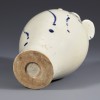
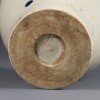
굽은 바닥을 납작하게 깎은 옥벽저(玉壁底) 형태입니다. 굽바닥에는 ‘大盈(대영)’이라는 글자가 음각으로 새겨져 있습니다. 이 명문은 중국 허베이성 일대 형요(邢窯) 유적에서 확인되는 관지 가운데 하나로 알려져 있습니다. 형요는 수·당 시기 북방을 대표하는 백자 가마입니다. 대영 명문은 당 현종의 대영고(大盈庫)와 관련된 표식으로도 해석되며, 궁중 재정과 연관된 명칭으로 알려져 있습니다. 조정에 공물을 바칠 때 사용된 궁중 전용 도자기로 추정됩니다.
此瓶制作于唐代(618~907年)的中国北部地区。口沿外撇,颈部先鼓起后向肩部过渡并略收。器物丰肩,肩以下渐收,整体呈葫芦状。
颈部饰有凸起的弦纹。肩部一侧附鸡首,一侧附尾羽,周围另贴附数个圆形装饰。鸡首的喙部、羽毛纹理及尾羽等细节,均以刻花技法加以表现。
器身正面施以青色颜料点饰,呈点纹状,似为点绘或喷溅而成。点纹大小与浓淡不一,部分向下流淌并延展成线状。通体均匀施以泛乳白色的白瓷釉,胎质细腻致密。
底部为削平的玉璧底。底足内刻有“大盈”二字铭文。该铭文被认为是中国河北一带邢窑遗址中所见的官用标记之一。邢窑为隋唐时期北方代表性白瓷窑口。“大盈”铭亦被认为是与唐玄宗时期大盈库相关的标识,与宫廷财政有关。该器推测为供奉朝廷的宫廷专用瓷器。
This is a northern Chinese white porcelain bottle produced during the Tang dynasty (618–907). The mouth flares outward, the neck swells and then narrows as it connects to the shoulder. The body expands at the shoulder and gradually tapers downward, forming an overall shape similar to a gourd.
A raised string band encircles the neck. On the shoulder are attached a chicken-head and tail-feather forms, along with several circular elements placed around them. Details such as the beak, feather texture, and tail are expressed using incised decoration.
The surface of the body is decorated with dotted patterns applied in blue pigment, appearing as if splashed or stamped. The dots vary in size and intensity, and some run downward to form elongated linear streaks. A milky-white porcelain glaze is evenly applied over the entire surface, and the clay body is fine and dense.
The base is finished in the form of a jade-disc foot, with the bottom cut flat. On the base, the inscription “大盈” is incised. This inscription is known as one of the kiln marks identified at Xing kilns in the Hebei region of China. Xing kilns were one of the representative northern white porcelain kilns during the Sui and Tang periods. The “大盈” inscription is also interpreted as a mark related to the Daying Treasury of Emperor Xuanzong of the Tang dynasty and is associated with imperial finances. It is therefore considered to indicate a court-use ceramic, possibly produced as tribute ware for the imperial court.